|
|
||||||||||||||||
|
|||||||||||||||||
|
|
Gorilla |
||||||||||||||||
|
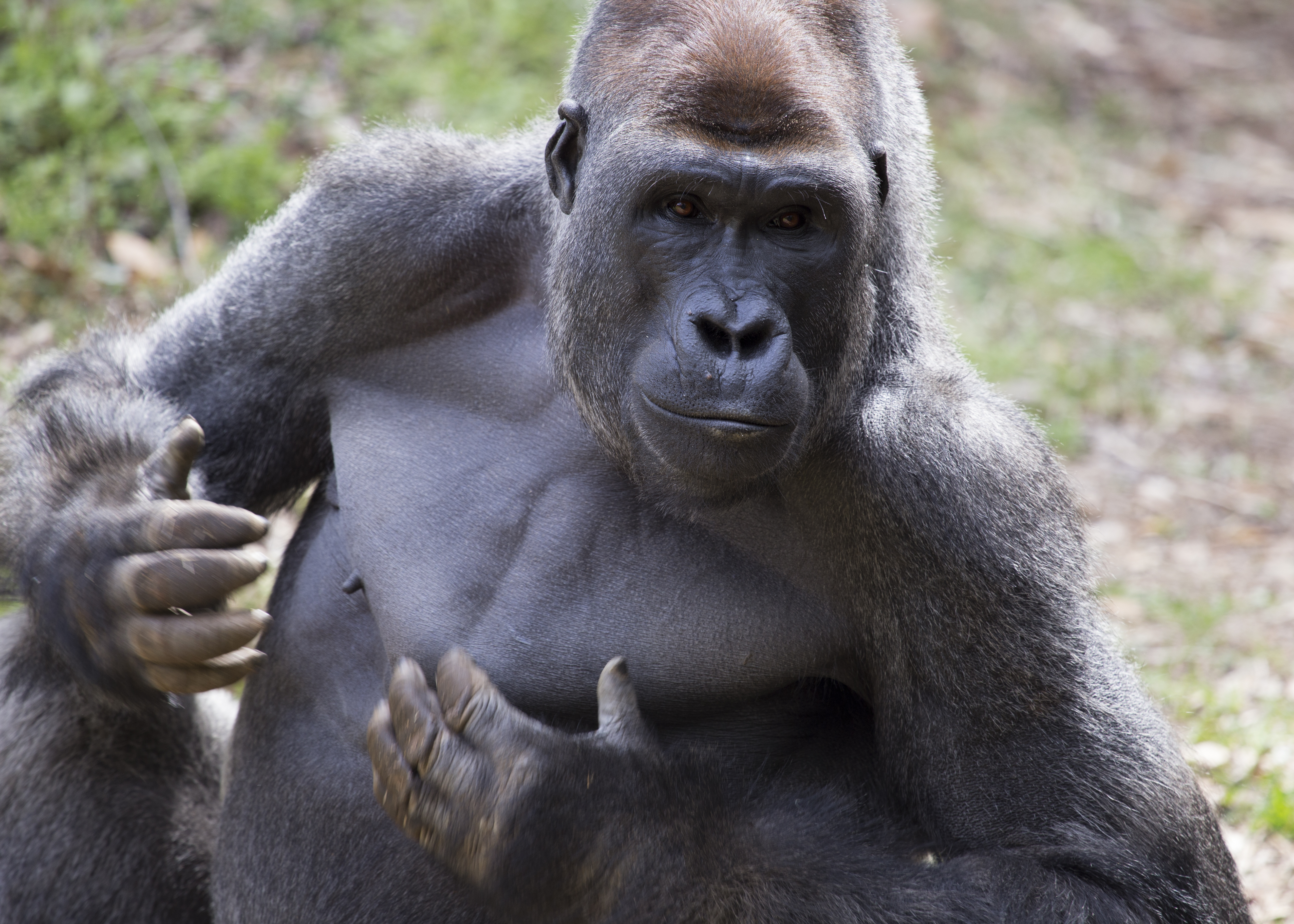
The western lowland gorilla has blue-black to brownish gray hair. Their bare skin
is black. Mature males have a silver or gray saddle on their back, thus they are
called “silverbacks”. Male gorillas that are not of breeding age are
called “blackbacks”. Gorillas have a robust build with a big stomach,
long thick arms, and short legs. Their hands and feet are wide with thick digits.
The hands are dexterous and can pick up amazingly small, delicate objects. Their
feet, like their hands, have opposable thumbs. Gorillas walk on all fours with their
fingers carried under, this develops calluses on their knuckles and preserves the
Gorilla FactsRangeCameroon, Zaire, Gabon Diet
Gorillas eat over 200 distinct species of plants, mainly leaves, buds, shoots, roots,
bark and fruit. Banana and sugar cane plantations are usually sought out. They also
eat termites and ants. BehaviorGorillas have very well developed social behavior. Their troop, or group, is a non-territorial harem that consists of 2 – 30 members. In general, the dominant male, or silver back, changes only with births or deaths however sometimes it may occur as a result of the addition of a solitary male. The home range, depending on habitat and size of the troop, is 7 – 9 square meters (8.4–10.8 sq. yd.) Their day range is 1 – 2 kilometers (.6–1.2 mi.) daily, and is not territorial. Diurnal, they are most active during the day, and wander casually, changing sleeping quarters daily and building new nests every night. When troops meet, they either disregard or greet each other, fighting is uncommon. The intimidating chest beating of a male gorilla is usually a bluff to scare off intruders, while the rest of his troop disappears into the forest. Staring is a sign of hostility to a gorilla. A direct gaze signals a challenge to the gorilla and may be stressful. ReproductionThe female becomes sexually mature at approximately 8 years of age, the male at approximately 11. The hierarchy within a troop is based on size and seniority and it determines mating. After 8 to 9 months, the mother gives birth to one baby, weighing 1.8–2.5 kilograms (4–6 lb.) Twins are rare. The young live with the mother for three years, with weaning commences at 1.5 years. Conservation Status
Listed by USFWS (United States Fish and Wildlife Service) as endangered and protected
by CITES. Gorillas are endangered due to increases in human population and the need
to cultivate more land for farming and cattle. The natural habitat of the gorilla
is shrinking. Poaching is also a problem for gorillas. LifespanIn captivity they live 40 – 50 years. In the wild, 30 – 40 years. Gorilla Conservation IssuesGeneral statementThere are two species and four species of gorillas found in Africa. Western gorillas, found in the countries of Nigeria, Cameroon, Gabon, Equatorial Guinea, Republic of Congo, Angola, and Central African Republic, are divided into the Cross River and western lowland subspecies. Both are considered critically endangered. Eastern gorillas, found in the countries of Democratic Republic of Congo, Uganda and Rwanda, are divided into the mountain gorilla and Grauer’s gorilla subspecies. Mountain gorillas are classified as critically endangered and Grauer’s gorillas as endangered. Threats to gorillas vary geographically. Western gorillas are primarily threatened by disease and the bushmeat trade. Threats to eastern gorillas include habitat loss and poaching. BushmeatThough habitat loss is often cited as the primary threat to wildlife, commercial hunting for the meat of wild animals (bushmeat) such as gorillas has become the most significant threat to the future of wildlife in Africa and around the world. Poaching of western gorillas in for food occurs despite the fact that they are protected under both national and international laws in all range states.
For thousands of years, bushmeat has been part of the subsistence of rural populations
in Africa. But as the population of Central Africa has become increasingly urbanized,
bushmeat has become a commercial trade, with meat fetching a high price on the black
market, consumed by the rich and middle class and sold in the US and Europe as well.
DeforestationAreas surrounding eastern gorilla habitat have some of the highest human population densities in the world. As a result, habitat has been destroyed to create farms and extract firewood or water. In western Africa, commercial logging is damaging large tracts of pristine forest and facilitates the bushmeat trade. In addition to loosing their homes and food, fragmented forests leave gorillas vulnerable to poachers, hunters and human disease transmission. Poaching/Pet tradeHistorically, gorillas were poached for their hands, feet, and heads and infant gorillas were captured for zoos or private collections. Whereas the trade in body parts has decline in the last few decades, gorillas infants are still captured for the pet trade. Because a group of gorillas will protect their young, the capture of an infant involves the death of its mother and often its father. Many of these animals do not survive or suffer severe physical and psychological damage. Political unrestPolitical unrest can create serious problems for wildlife. Political instability can make it difficult for wildlife authorities to protect endangered species and their habitats. Often people displaced from war will rely on hunting as a means of support for their families.
Diseases
|
|||||||||||||||||
|
© 2009 Ape TAG® |
|||||||||||||||||
| Home | About the TAG | About Apes | Conservation | How You Can Help | |||||||||||||||||