|
|
||||||||||||||||
|
|||||||||||||||||
![]() |
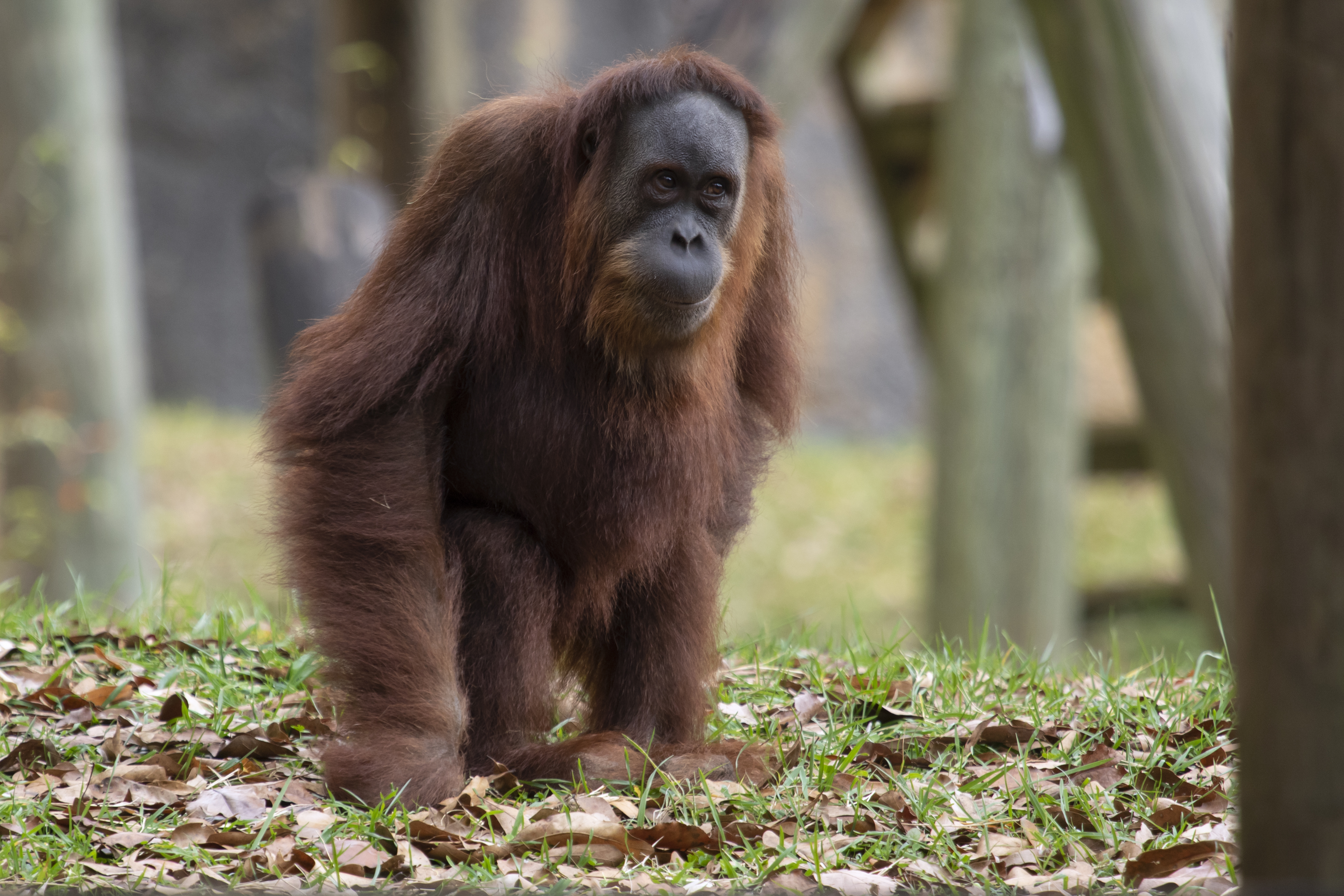
Orangutan |
||||||||||||||||
|
The orangutan is the largest tree-living animal in the world. Males stand approximately
4½ ft. and weigh approximately 90 kg (200 lbs.). Females stand approximately
3½ ft and weigh about 50kg (110 lbs.). The body is covered with a dark rufous
or reddish brown, rather thin, shaggy coat. The arms are 1½ times longer
than the legs and large adult males can have an armspan as long as 8 feet. The shoulder
and hip joints are extremely supple, allowin Orangutan FactsRange
Orang HabitatOrangutans inhabit tropical rainforest as well as peat swamp forest. They primarily utilize the middle canopy. Large tracts of mature forests are needed to sustain this species. It is estimated that suitable orangutan habitat in Malaysia and Sumatra has declined by more than 80% in the last two decades. Diet
There are more than 300 different food items identified in their diet, and most
of them are fruits. Some of the fruits that orangutans consume include jackfruit,
durian, langsat, mangosteen and breadfruit. Several of these fruits are very spiny
and thus require a form of “preparation” before Behavior
Orangutans have complex social relationships and are not as solitary as once believed.
While not as social as their African counterparts, they are capable of forming strong
social attachments. Their size and arboreal lifestyle make the formation of large
groups impractical, since the fruit-bearing trees they inhabit would be able to
neither physically support large groups, nor provide enough fruit to sustain a large
group. The bond between mother and offspring is strong and the infant stays with
its mother for up to ten years. This is the longest childhood of any ape species.
Adult females with young often form short-term groups and sub-adult males sometimes
associate with adult females. Adolescent females also sometimes travel together
when the age difference is minimal. Mature males are generally intolerant of each
other. Approximately 60% of the daylight hours are spent in search of, and consuming,
food. Each night a new nest is built approximately 40 or 50 feet up in a tree. Although
orangutans are almost exclusively arboreal, males will come to the ground to move
between stands of trees. Because of their larger bulk, the males tend to stay lower
in the canopy than the females, which reduces competition for food when their ranges
overlap. Tool use in both wild and captive orangutans has been well documented.
This includes making ite Conservation StatusBoth species of orangutan are considered endangered, with the Sumatran listed as critically endangered by the IUCN Red List. Both have been covered under Appendix I of the Convention on International Trade in Endangered Species (CITES) since July 1975. Rampant exploitation and conversion of the tropical rainforest for a variety of human interests (primarily for use in the commercial palm oil industry, and logging for industrialized countries), coupled with a booming human population in the area have contributed significantly to the alarming decline. Fires, both unintentional and intentional, have claimed the habitat and lives of many, or have flushed out individuals who are then slaughtered for food. One fire alone, which raged through Borneo in 1997/1998, was thought to have claimed one third of the existing population. In addition, the practice of killing mothers and selling their infants as pets still continues and has led to a staggering number of orphans in captivity. Current estimates put the wild Bornean population at approximately 45,000-50,000 and the Sumatran population at approximately 7,000. Reproduction
Females reach sexual maturity between the ages of eight and twelve, although in
the wild they don't usually give birth until a few years later. The estrus cycle
is generally 28 to 32 days. Gestation is 233 to 265 days. The single young is born
weighing approximately 1.5 kg (3½ lbs.). Because of the solitary nature of
the orangutan, the bond that forms between mother and offspring is very strong.
Females do not give birth again for five years, and sometimes it can take as long
as eight years. This makes their reproduction rate the slowest of any of the great
ape species. Males reach puberty at approximately age seven or nine, but the cheek
pads, which are considered secondary sexual traits, may not be fully developed until
age 14 or even later. Researchers have reported for some time that females are not
receptive to males until the males reach full maturity, with developed cheek pads
and a well-developed throat sac capable of emitting loud cries known as long calls.
LifespanIn captivity orangutans can live upwards of 50 years. Lifespan for wild individuals is probably closer to 40 years. Sources
Orangutan Conservation IssuesDeforestation
As human populations grow larger in Indonesia and Malaysia, the two countries that
govern the remaining areas of orangutan habitat, they have begun to place larger
demands on their natural resources. For the last few decades, this has resulted
in the growth of an ever-increasing timber industry. From the 1960’s onward,
the forests were harvested for tropical hardwoods. These particular types of trees
grow very slowly so both the trees themselves as well as the ecosystems they support
have great difficulty in recovering. As these trees are very large, when they are
felled they t
More recently, the forests of Borneo have been cut to make way for palm oil plantations.
This industry has grown by large leaps over the last few decades. Malaysia is the
world’s largest producer of palm oil, having more then 38,000 square km of
palm oil plantation. The Island of Borneo alone has 27,000 square km of palm plantation.
The slash and burn method often employed in these areas leaves the soil very poor
which means its productivity is very short-lived. Once the land becomes infertile,
the plantation needs to move on to a new area, and cut down more forest.
As a result of the pressure created by increasing numbers of humans, the timber industry, and the palm oil industry, current estimates put the remaining orangutan habitat at just twenty percent of what it was during the early 20th century. Based on these numbers and the increasing demand for palm oil, some theorize that the entire orangutan habitat on Borneo and Sumatra could be wiped out within the next ten years. Pet TradeAlthough orangutans have been used in the entertainment industry in the past, this practice has slowed considerably. One of the last Hollywood orangutan trainers recently gave up their remaining apes to the Great Ape Trust in Des Moines, Iowa, where they will be permanently retired from their previous “working” life.
A much greater threat to wild orangutans is the pet trade. As babies, they are small,
cute, and sociable. This makes them very attractive as pets. What people don’t
realize is that they will grow quite large and become potentially dangerous wh Though many Asian countries have begun to pass laws about keeping wild orangutans as pets, the trade still occurs. As recently as 2004, a shipment of 100 Bornean orangutans was confiscated in Thailand. It’s estimated that for each orangutan successfully introduced into the pet trade, 4 or 5 others were killed in the process (mothers being killed to simplify the capture and/or babies who simply do not survive the capture and transport process). This one confiscation alone could represent the loss of 1% of the world’s entire population of Bornean orangutans. Stronger laws, harsher penalties, and better enforcement of these laws will be needed to curb this impact to the ape’s dwindling wild population. Disease
While the threat of disease has not yet accounted for a significant portion of the
species’ decline, it has the potential to be devastating. The eco-tourism
industry in Borneo and Sumatra is growing. A significant draw fo Online Resources
AZA Orangutan SSP Status
The Orangutan Species Survival Plan (SSP) guides the management of orangutans living
in North American zoos. The SSP plans the strategic captive breeding for both Sumatran
and Bornean species of orangutans and oversees many health, behavioral and in-situ
studies. Involvement in these studies helps the SSP and zoos understand the needs
of orangutans in captivity and wild populations. The SSP also supports the Orangutan
Conservancy’s conservation efforts and works to build interest in orangutans
by providing zoos with curriculum and materials for school programs.
As of June 2002, there are 73 Bornean orangutans, and 99 Sumatran orangutans held in 54 AZA institutions. (There are also 46 sub specific hybrids in 23 institutions.) The Orangutan SSP not only develops a strategic captive breeding plan for the two species, but also coordinates and oversees many health and behavioral studies. These help us to better understand the needs of this taxon in captivity, as well as to find out how this information might apply to the conservation of wild populations. The Orangutan SSP Field Advisor also keeps the SSP informed regarding the status of projects taking place in-situ. Participating zoos are encouraged to financially or materially support these approved projects. Through specific educational programming, the SSP hopes to coordinate and facilitate education and direct conservation action on an even broader scale in the near future. |
|||||||||||||||||
|
© 2009 Ape TAG® |
|||||||||||||||||
| Home | About the TAG | About Apes | Conservation | How You Can Help | |||||||||||||||||